
Donor Engagement Strategy
This guide is designed to help Palestine campaigners build meaningful relationships with donors — beyond the first donation. Donor engagement is not about asking louder. It is about showing up with intention, consistency, and care.
Your Donor Data Belongs to You
Chuffed gives campaigners full access to their donor data — including names, contact details, and giving history. You can download this at any time from your campaign dashboard. You can even automate journeys from your campaign dashboard.
This means you can:
Thank donors personally, by name
Track giving patterns over time
Identify your most loyal and generous supporters
Reach out directly — by email, phone, or message
Invite donors to follow you on social media, join your newsletter, or stay connected beyond a single campaign
Use it. It is one of the most powerful tools available to you.
A Note on Privacy
You must not contact donors who have opted out of communications. Always check opt-out status before reaching out directly by 'Accessing your Donation Data'. Donors who have unsubscribed or indicated they do not wish to be contacted must be respected — no exceptions. If you are unsure how to check opt-out status for your campaign, contact support@chuffed.org before sending any direct outreach.
Thank-You Emails
Why This Is Non-Negotiable
A thank-you email is the single most important donor communication you will send. Most platforms send an automated receipt. That is not a thank-you. A real thank-you is personal, specific, and timely.
When to Send
Within 24–48 hours of a donation
After a campaign milestone (50% funded, fully funded)
When you share a significant update or outcome
What Makes a Good Thank-You
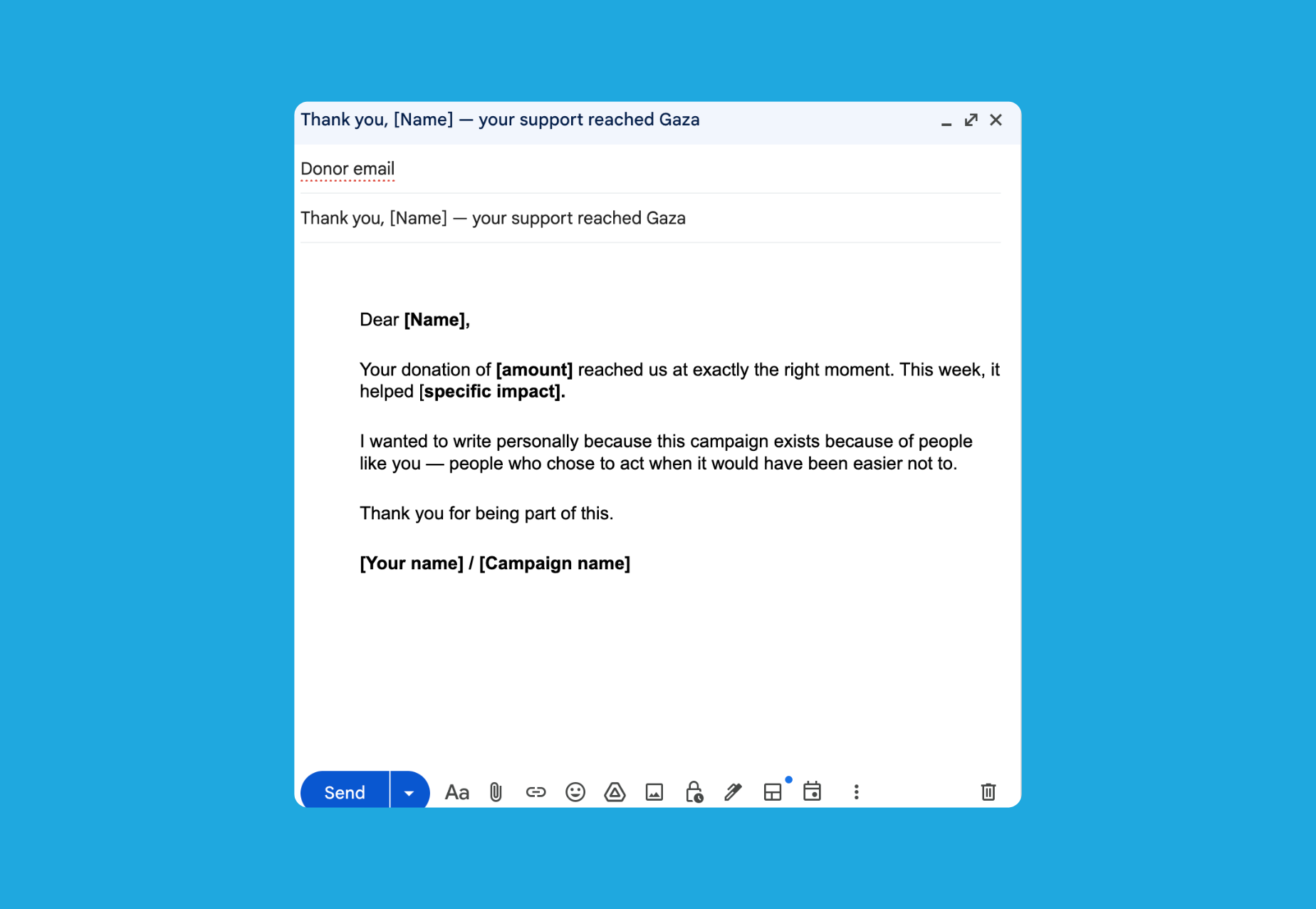
Use the donor’s first name
Reference the amount or the specific campaign — not a generic message
Tell them what their donation makes possible, concretely
Keep it short: 3–5 sentences is often more powerful than a long message
Include a human sign-off — from you, not ‘the team’
Sample Thank-You Email — First-Time Donor
Tiered Donor Strategy
Not All Donors Are the Same — and That’s Okay
A tiered approach means giving more attention to donors who give more, while still honouring everyone who contributes. This is not about valuing people differently. It is about allocating your time wisely.
Tier 1 | Tier 2 | Tier 3 | |
Donor Level | Large Donors | Mid-Level Donors | All Donors |
Giving Range | $500+ | $50-$499 | Any amount |
Outreach Type | Personal email or call | Segmented email | Automated/broadcast email |
Recognition | Named, treated as partners | Repeat donors acknowledged | Thank-you message |
Updates | Personalized impact updates | Milestone-based updates | Regular campaign updates |
Engagement | Matching, partnerships, amplification | Community involvement | Feel part of something real |
How to Identify Your Tiers
Download your donor data from your Chuffed campaign dashboard. Sort by donation amount. Over time, also note:
Repeat donors (gave more than once)
Donors who shared your campaign
Donors who left comments or messages
Donors connected to organisations, mosques, or community networks
These signals matter as much as donation size
Personalised Updates for Large Donors
Why Personalisation Builds Loyalty
Large donors often give because they feel a deep connection to the cause. A broadcast update says ‘we raised $10,000 this week.’ A personalised update says ‘your gift helped make that possible — and here is what it funded.’
That difference is significant. It turns a donor into a long-term partner.
What to Include
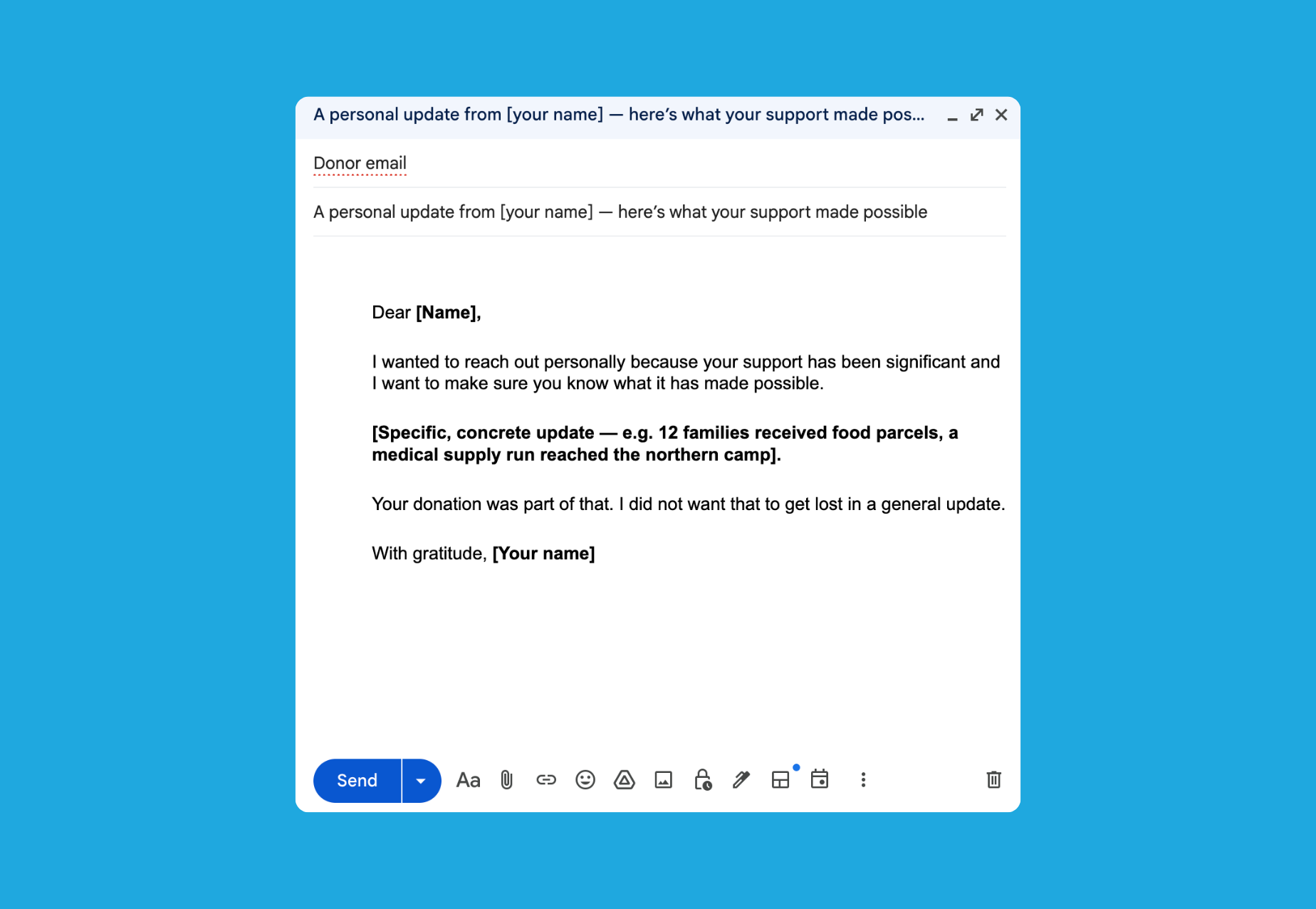
A specific reference to their donation and the impact it had
A detail or story not shared publicly
A photo, voice note, or short video if possible
An invitation to stay connected or ask questions
A gentle ask — to share, to match, or to give again — only if appropriate
Cadence
At least once per campaign, more for longer campaigns
Always after a major milestone or campaign close
A brief mid-campaign personal note for donors giving $500+
Sample Personalised Update — Large Donor
Using Large Donors to Unlock Partnerships & Matching
Your Donors Are a Network, Not Just a List
Large donors are often professionals, business owners, or community leaders connected to organisations with resources beyond their personal giving capacity.
A thoughtful conversation with a large donor can open the door to:
💕 Donation matching (their company or network matches contributions)
🤝 Organisational partnerships (a business, mosque, or community group fundraises alongside you)
📢 Amplification (they share your campaign to their networks, which may be much larger than yours)
🙌 In-kind support (goods, services, logistics, communications)
You do not need to be transactional about this. The conversation starts with gratitude and relationship — not with an ask.
How to Approach the Conversation
Start with a thank-you and a personal update
Share the campaign’s broader goals and challenges honestly
Ask if they know others who might be moved by the cause
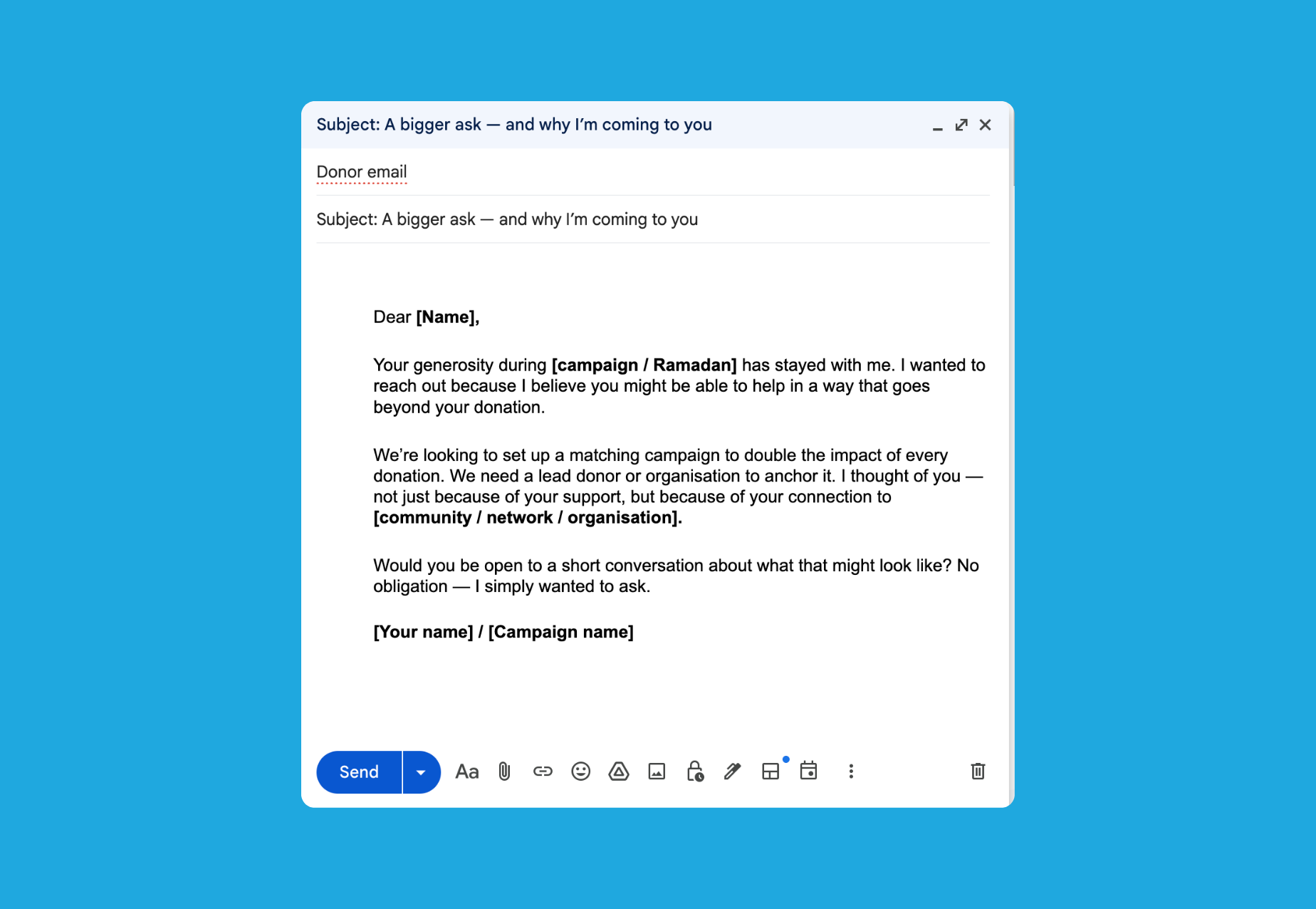
If the moment is right, ask directly: ‘We’re exploring matching — is that something you or your organisation could support?’
Make it easy: provide a simple one-pager or campaign link they can forward
Donation Matching: How It Works
Matching is one of the most powerful tools in fundraising. It can double or triple your campaign income and creates urgency for new donors.
How to set it up: A large donor agrees to match every donation up to a set amount — e.g. ‘The next $5,000 raised will be matched 1:1.’
How to promote it: Feature the match prominently on your campaign page, in updates, and on social media. Create a deadline — matching campaigns with time limits perform significantly better.
Who to approach: Look at your Tier 1 donors first. Also consider local businesses, mosques and Islamic centres, diaspora organisations, and professional networks.
Sample Email — Inviting a Large Donor to Become a Partner
Inviting Donors Into Your Wider Community
A Donation Is a Starting Point, Not an Endpoint
Most donors give once and disappear — not because they stopped caring, but because they were never invited to stay. Your job is to invite them deeper into the cause.
Donors who follow you across channels are more likely to:
Give again
Share your campaign with others
Become advocates, not just supporters
Support future campaigns when this one ends
Channels to Invite Donors Into
Newsletter or email list: You can already update your supporters in Chuffedd. If you have an external newsletter, invite donors to sign up. This is the channel you own — it does not depend on an algorithm. Even a simple monthly update keeps the relationship alive.
Social media: Include your Instagram or other handles in every campaign update and thank-you email. A simple line like ‘Follow us on Instagram @yourhandle for real-time updates’ is enough. Tag @wearechuffed when you cross-post.
WhatsApp or community groups: Some campaigners build donor or supporter communities on WhatsApp or Signal. These create a sense of belonging and make donors feel like insiders, not just contributors.
Future campaigns: Let donors know explicitly: ‘We will run again during [Ramadan / next year / when the need arises]. If you’d like to be the first to know, reply to this email.’
When and How to Ask
The best moment to invite a donor to another channel is immediately after they give — in the thank-you email or the first update they receive. Keep it light:
One channel, not five
A reason why it matters: ‘This is where we share updates that don’t make it into the campaign page’
No pressure — an invitation, not a demand
Donors who follow you on more than one channel are not just donors. They are community members.
Encouraging Repeat Giving
One-Off Donors vs. Sustained Supporters
The difference between a campaign that struggles and one that builds momentum is often repeat giving. A donor who gives twice is more than twice as valuable — they are a signal of trust.
How to Invite Repeat Giving Without Pressure
Frame it as re-engagement, not a new ask: ‘The need continues — here’s what’s happened since you last gave’
Use campaign updates as natural moments to invite a second gift
Show what has changed or been achieved since their last donation
Make it easy: link directly to the campaign page
What Not to Do
❌ Do not email donors every day asking for money — it erodes trust
❌ Do not send a repeat ask without a genuine update attached
❌ Do not make donors feel guilty — invite them, don’t pressure them
Donor Engagement Rhythm
Use this as a campaign checklist. You do not need to do everything — but you should do something at every stage.
Timeframe | Actions | |
☑️ | Within 48 hours of a donation |
|
☑️ | Week 1–2 |
|
☑️ | Mid-campaign |
|
☑️ | Campaign close |
|
☑️ | Post-campaign |
|
Final Reminder
Donor engagement is not about squeezing more money from people who have already given. It is about honoring the trust they placed in you — and building the kind of relationship that sustains a cause over time.
Your donors chose your campaign from among many.
They believed you. Treat that belief with care.